


Angus Cereals – does central storage maximise financial returns for farmers?
 Angus Cereals is a grain storage and drying facility planned for construction at the port of Montrose. It will serve cereal growers in the Perth, Angus and Kincardine areas. Yesterday, in the Scottish national and regional press, it made an appeal for more cereal growers to invest in the project in the next fortnight to ensure Stage 1 of the project proceeds as planned. The articles illustrate the many advantages for farmers of investing in central storage, though I feel that the economic reasons for investment are a little less clear.
The advantages detailed are numerous but essentially relate to offering farmers peace of mind in post harvest. Advantages included; no need to arrange labour for grain drying or transport, drying and storage does not interfere with other on farm activity, no need to worry about rejected loads and, once in store, the grain will be professionally marketed by Openfield, the UK’s largest farm-owned grain business. The system advocates crops going off farm immediately after harvesting and straight to Angus Cereals.
There is no doubt that this would mean less work for the farmer but do these proposed “operational efficiencies” result in an improved economic return for the producer? Regardless of wheat prices, be they favourable as they are now or poor as they were only last season, is the most prudent business decision to add the maximum value to a crop on-farm before sale or have the entire process managed through investing in a central storage scheme like Angus Cereals?
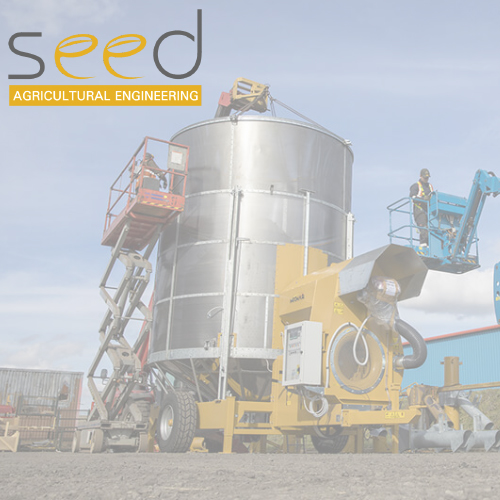
One of the most significant costs post harvest is drying the crop to a safe moisture content for storage. Both articles seem to have given little consideration to the cost of this process. Drying is highly important in Scotland, generally a very significant proportion of crops require drying before storage. Angus Cereals advocates transport straight from field to store, where the crop will be cleaned and dried at a cost to the farmer. This work could be conducted on-farm using a mobile batch grain drier, like the Seedar. Both options achieve the same drying results but the economics are quite different.
To illustrate this, take the example given in the Scotsman. Sending 1000 tonnes of harvested premium grains to store, assuming 75% of the crop requires drying from 20% moisture content (mc) to 14.5% mc, the safe moisture content for storage. To achieve this an indicative Scottish central storage drying charge for 2010 is £16 per tonne. Whilst, using a SeedarD 18 T grain drier the cost per tonne is approximately £7.50 (covering all capital and operational expenditure).
Additionally, there are weight loss charges to consider. After applying the central storage weight loss factor of 9% there is calculated to be 910 tonnes of dried crop ready for storage. Calculating actual grain shrinkage and handling losses on-farm the farmer would be left with 936 tonnes in on-farm storage.
As a result the farmer who conducts drying on-farm is in a far strong financial position. This is due to the significantly lower cost of drying and the reduced actual weight loss figure.
Furthermore, as a result of on-farm drying and storage the farmer retains control of how the crops are marketed. This means a greater range of management options are available to ensure the greatest economic return from the produce.
It must be remembered that this is an example to provide food-for-thought when considering grain drying, storage and marketing options. As farmers ourselves we believe in adding the maximum value to our produce and prefer to maintain control over our marketing strategy, we find this yields better returns in our situation. Although, we know that each farm is very different and has a unique set of requirements. As a result different management options must be pursued on each.
For some, the benefits of investing in Angus Cereals will outweigh the benefits of carrying out the same processes on-farm, while for others, on-farm drying, storage and marketing is financially advantageous. For all considering investment in Angus Cereals it is ultimately a trade off between the economic value of the peace of mind offered by central storage and the improved financial returns of completing this work on-farm.
Investing in drying and storage facilities throws up difficult choices and care must be taken to consider all alternative options before making a decision. We hope that this post has constructively contributed to this process.
To receive email updates on new blog content just click here
29 September 2010 John McArthur Drier Options Tags: Angus Grain, Central Storage, Economics, Openfield, Press and Journal, Scotland, Scotsman